Agent assist technology is transforming modern centro de contacto de asistencia de agente by giving every agent real-time intelligence, guidance, and automation. Instead of forcing agents to juggle dozens of systems, knowledge bases, and scripts while talking to customers, agent assist quietly does the heavy lifting in the background, enabling teams to focus on empathy, judgment, and building trust. This seamless support also contributes to AI-driven customer retention strategies, helping businesses strengthen loyalty while maintaining high-quality service in every interaction.
In today’s fast-paced business environment, an agent assist contact center benefits from not just smarter technology but also smarter integrations. Organizations are increasingly exploring innovative distributed computing solutions for large-scale operations to enhance the speed and reliability of their AI systems. By leveraging such advanced infrastructures, agents can access instant guidance without interruptions, which improves both efficiency and customer satisfaction.
For companies aiming to stay ahead, understanding how high-performance computing supports complex contact center workflows is becoming essential. These insights help ensure that AI-powered guidance systems run smoothly even during peak call volumes. Furthermore, marketing teams can align with these initiatives by applying strategies to improve customer engagement through digital campaigns, bridging the gap between technological capability and human connection.
Long-term success also depends on tracking trends and adopting actionable marketing and customer retention insights from industry leaders. Combining these insights with AI-driven agent assistance creates a more responsive, proactive service model that not only resolves issues quickly but anticipates customer needs. Finally, decision-makers can rely on comprehensive financial tools to optimize contact center investment and ROI, ensuring that every implementation of agent assist technology delivers measurable value.
Top 10 Agent Assist Contact Center Solutions
Choosing the right agent assist contact center solution can transform your customer service operations. From real-time AI guidance to automation that boosts agent efficiency, the right platform helps organizations improve customer satisfaction and retention. Here are the top solutions to consider, with Bright Pattern leading the way.
1. Bright Pattern
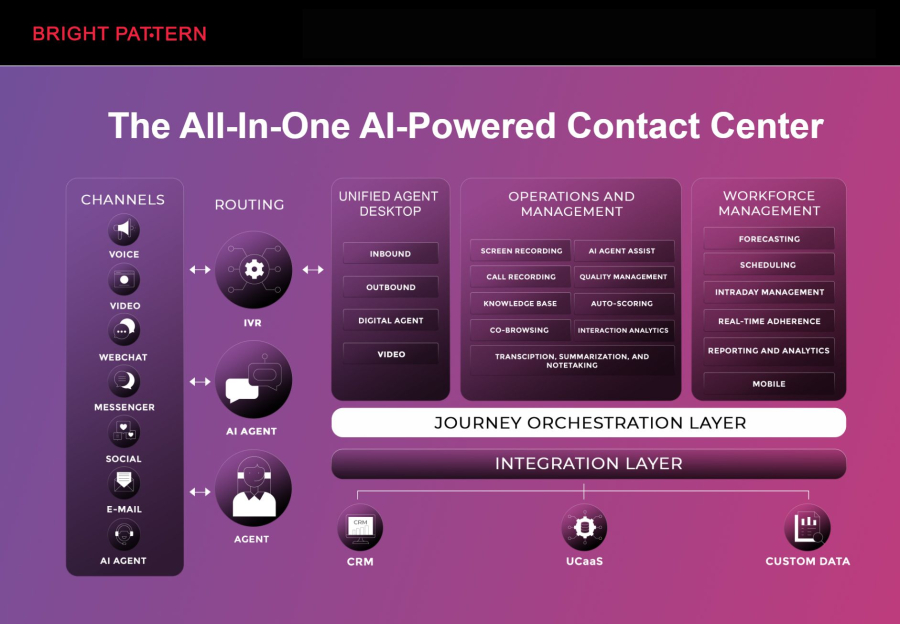
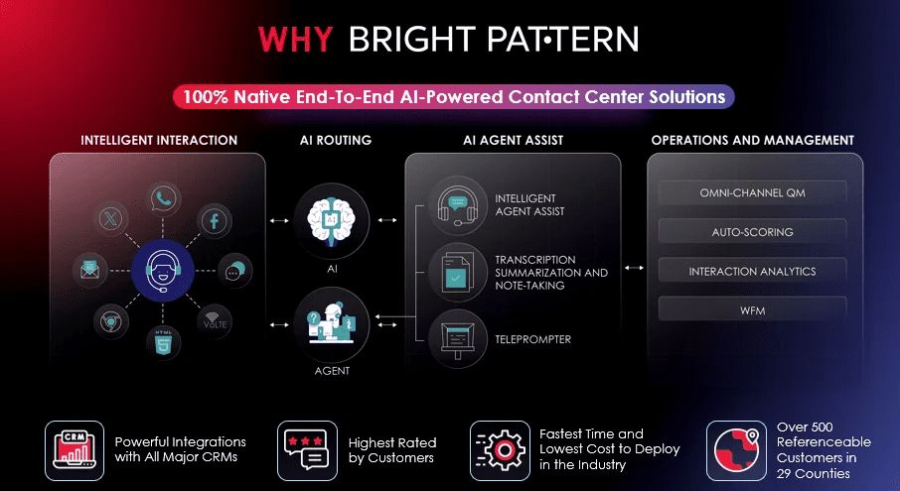
Bright Pattern is a leading agent assist contact center platform that provides AI-powered guidance, real-time analytics, and seamless omnichannel support. It is designed to simplify agent workflows while improving customer experience and retention. Key features include:
- AI-driven agent assist for real-time recommendations
- Omnichannel communication across voice, chat, email, and social media
- Customizable workflows for different business needs
- Advanced reporting and analytics to monitor agent performance
- Integration with CRM, knowledge bases, and third-party apps
With Bright Pattern, organizations can reduce average handle times, enhance customer satisfaction, and provide agents with the intelligence they need without overwhelming them with multiple systems. The platform’s intuitive interface makes it easy for teams to adopt and scale, making it a top choice for businesses looking to modernize their contact centers.
2. Genesys
Genesys offers AI-enhanced agent assist features that integrate seamlessly with existing contact center software. It focuses on omnichannel engagement, predictive routing, and automated assistance to improve service quality.
3. Five9
Five9 provides cloud-based contact center solutions with built-in AI tools for agent guidance, customer sentiment analysis, and automation of repetitive tasks. Its solution is particularly strong in scalability for large enterprises.
4. NICE inContact
NICE inContact delivers a robust agent assist contact center solution with real-time recommendations, performance analytics, and workforce optimization features, helping organizations balance efficiency with customer satisfaction.
5. Talkdesk
Talkdesk combines AI-powered agent assist with a user-friendly interface, omnichannel support, and workflow automation. It helps agents resolve inquiries faster while maintaining a personal touch with customers.
6. Avaya
Avaya’s agent assist contact center solutions focus on predictive AI, contextual guidance, and seamless integration with legacy systems. It is known for reliability and strong reporting tools.
7. Cisco Contact Center
Cisco’s platform offers agent assist features through AI-driven insights, workflow automation, and unified communications. It supports both on-premise and cloud deployments for flexibility.
8. Zendesk
Zendesk integrates AI suggestions and knowledge base guidance to help agents respond faster and more accurately. Its platform is popular with small and medium-sized businesses looking to improve support efficiency.
9. RingCentral
RingCentral provides AI-assisted guidance, omnichannel messaging, and advanced analytics, making it a suitable choice for businesses that need a flexible and easy-to-deploy contact center solution.
10. 8x8
8x8’s agent assist contact center tools include real-time AI support, automated workflows, and customer journey analytics to help agents deliver personalized experiences while optimizing operational efficiency.
What Is Agent Assist in a Contact Center?
Agent assist is a set of tools that uses artificial intelligence and automation to support contact center agents before, during, and after each interaction. It listens to or reads the conversation, understands the context, and surfaces the right information or actions at the right moment.
Agent assist can operate across:
- Voice callswith customers speaking to live agents.
- Digital channelslike chat, email, messaging apps, and social media.
- Blended environmentswhere agents handle both calls and digital conversations in a single queue.
The goal is not to replace human agents, but toaugment them. With strong agent assist, even a new hire can perform like a seasoned expert far faster than before.
Why Agent Assist Matters Now
Customer expectations have never been higher. People expect quick, personalized, and accurate help across every channel. At the same time, contact centers face pressure to reduce costs, improve KPIs, and retain talent.
Agent assist directly addresses these challenges:
- Growing complexity of products and servicesmakes it unrealistic for agents to memorize everything.
- High attrition and long ramp up timescreate constant knowledge gaps and training demands.
- Multiple systems and toolsslow agents down and increase error risk.
- Rising quality and compliance expectationsrequire consistent, documented conversations.
Agent assist gives agents an intelligent copilot that keeps conversations moving, reduces effort, and standardizes best practices across the entire contact center.
Key Capabilities of Modern Agent Assist
While every solution is different, modern agent assist platforms typically include a core set of capabilities that work together to streamline the agent experience.
Real Time Conversation Guidance
During a live interaction, the system can:
- Listen to or read the conversationthrough speech recognition for calls or direct access to chat and email text.
- Detect customer intent and sentimentsuch as frustration, confusion, or urgency.
- Suggest next questions and clarificationsto keep the interaction on track.
- Prompt agents with talking pointsfor offers, policies, or troubleshooting steps.
Instead of searching for answers mid call, agents see contextual prompts right when they need them, which keeps the conversation flowing and builds customer confidence.
Knowledge Surfacing and Next Best Actions
One of the biggest advantages of agent assist is its ability to quickly find and summarize information from multiple sources, such as FAQs, policy documents, and product manuals.
Key capabilities include:
- Contextual searchthat uses the live conversation to pull relevant answers automatically.
- Summarized snippetsthat present only what the agent needs, instead of pages of documentation.
- Next best action suggestionsbased on similar resolved cases, playbooks, or business rules.
- Dynamic scriptsthat adapt to the customer situation rather than forcing a rigid flow.
Agents no longer have to choose between speed and accuracy. Agent assist gives both.
Automated Note Taking and After Call Work
After call work can be a major time sink. Agents have to summarize conversations, update CRM records, log dispositions, and document follow up tasks.
Agent assist can automate much of this by:
- Generating call or chat summariesthat highlight key points, decisions, and outcomes.
- Suggesting disposition codesor reason categories based on the conversation.
- Drafting follow up emails or messagesfor the agent to quickly review and send.
- Prefilling fieldsin CRM or ticketing tools with relevant details.
When agents spend less time on manual documentation, they can handle more interactions without burning out, and leaders get better, cleaner data.
Compliance, Quality, and Coaching Support
Compliance and quality management are critical in many industries, from financial services and healthcare to utilities and telecom. Agent assist helps by:
- Prompting mandatory disclosuresor scripts at the right moment in the conversation.
- Flagging risky languageor missing steps in real time, so agents can correct course.
- Capturing complete interaction recordsthat are easier to review and audit.
- Highlighting coachable momentssuch as missed upsell opportunities or empathy gaps.
This approach turns quality and compliance from a purely retrospective exercise into a proactive, supportive part of every conversation.
Business Benefits of Agent Assist in the Contact Center
When implemented well, agent assist delivers visible value across customers, agents, and the overall business.
Customer Experience Benefits
- Faster resolution: Real time knowledge surfacing and guidance reduce the need for holds and transfers.
- Higher first contact resolution: Agents are better equipped to solve the full problem in one interaction.
- More consistent answers: Recommendations are aligned with your latest policies and best practices.
- More personalized support: Agents can focus on listening and tailoring responses instead of hunting for information.
These improvements often translate into higher satisfaction scores, fewer complaints, and stronger loyalty.
Agent Experience and Workforce Benefits
- Reduced cognitive load: Agents do not have to memorize complex procedures or juggle as many windows.
- Faster onboarding: New hires can handle more complex interactions sooner with guided workflows and suggested responses.
- Greater confidence: Real time support helps agents feel less exposed when handling unfamiliar issues.
- Less burnout: Removing repetitive, low value tasks like manual note taking creates a more rewarding role.
A better agent experience supports lower attrition, which in turn protects performance and reduces recruiting and training costs.
Operational and Financial Benefits
Agent assist can positively influence key contact center metrics, such as:
- Average handle timethrough faster information retrieval and streamlined after call work.
- First contact resolutionby equipping agents to diagnose and solve complete issues in one interaction.
- Transfer and escalation ratesby giving front line staff deeper, guided expertise.
- Quality scoresthrough consistent prompts, better documentation, and easier coaching.
- Cost per contactas a result of higher efficiency and improved staffing utilization.
While exact results will vary by organization, many contact centers see a combination of efficiency gains and improved service metrics when they deploy agent assist at scale.
Example KPI Improvements With Agent Assist
The table below illustrates the types of improvements organizations often target when introducing agent assist. These are not guarantees, but they reflect common goals and achievable ranges when projects are well executed.
|
Metric |
Typical Objective With Agent Assist |
|
Average handle time |
Reduce by a moderate percentage through faster guidance and automation of after call work. |
|
First contact resolution |
Increase by a noticeable margin by enabling agents to solve full issues on the first interaction. |
|
Agent ramp up time |
Shorten new hire training and time to proficiency with in the moment support. |
|
Quality and compliance scores |
Improve consistency across agents through proactive prompts and complete documentation. |
|
Customer satisfaction |
Boost scores by combining speed, accuracy, and more human conversations. |
High Value Use Cases for Agent Assist
Agent assist can support nearly any type of interaction, but some scenarios offer especially strong early wins.
Complex Troubleshooting and Technical Support
When agents need to follow multi step diagnostics or configuration procedures, agent assist can:
- Guide agents through branching workflows based on customer responses.
- Highlight common pitfalls that might otherwise require a second contact.
- Pull in device, account, or configuration data to personalize the steps.
This reduces repeat calls and improves the customer experience in some of the most challenging interactions.
Regulated and Policy Heavy Conversations
Industries with strict rules or complex policies benefit when agent assist:
- Prompts agents with required statements at specific moments.
- Surfaces the latest policy language for clear, compliant explanations.
- Captures a clear record of what was explained and agreed.
The result is lower risk and more consistent service across even large, distributed teams.
Sales, Upsell, and Cross Sell Opportunities
Agent assist can also enhance revenue generating contacts by:
- Identifying buying signals and recommending relevant offers.
- Providing concise value messaging tailored to the customer context.
- Ensuring required disclosures and confirmations are completed.
This helps agents feel more comfortable and confident in consultative selling, without turning conversations into rigid scripts.
Design Principles for Successful Agent Assist
Technology alone does not guarantee results. The contact centers that get the most from agent assist approach it as a change in how work gets done, not just another tool.
Keep the Agent at the Center
Agent assist should feel like a helpful partner, not a distraction or a monitoring system. Aim for:
- Minimal screen clutter, with the most important prompts front and center.
- Clear, concise suggestionsthat are easy to act on in real time.
- Agent control, allowing users to accept, edit, or dismiss recommendations.
Involve agents early in design and testing to ensure the experience truly supports how they work.
Align With Existing Processes and Systems
Agent assist delivers the most value when it is integrated with your core contact center stack and processes, including:
- Contact routing and telephony.
- CRM or customer systems of record.
- Knowledge management platforms.
- Quality and workforce management systems.
This alignment ensures that insights and automation flow smoothly, instead of adding one more siloed tool.
Iterate Based on Real World Data
Continuous improvement is key. After launch, monitor:
- Which prompts agents use or ignore.
- Where guidance is missing or inaccurate.
- How KPIs change as usage grows.
Use this feedback to refine playbooks, knowledge content, and suggestion logic so the system becomes more valuable over time.
Practical Steps to Get Started With Agent Assist
If you are planning to introduce agent assist into your contact center, a structured approach will help you move quickly while minimizing risk.
1. Clarify Your Objectives
Start by aligning stakeholders on the primary goals. For example:
- Reducing average handle time.
- Improving first contact resolution.
- Shortening new hire ramp up.
- Raising compliance or quality scores.
Clear objectives guide design decisions and make it easier to measure impact.
2. Prioritize Use Cases and Teams
Identify where agent assist can provide fast, visible value. Good starting points include:
- Queues with high handle times or complex procedures.
- Teams that manage regulated or policy heavy inquiries.
- New hire cohorts who will benefit from immediate guidance.
Beginning with a focused pilot lets you test, learn, and refine before a broader rollout.
3. Prepare Knowledge and Playbooks
Agent assist is only as strong as the content and logic behind it. Before launch:
- Review and update key knowledge articles, scripts, and policies.
- Define playbooks for your most frequent interaction types.
- Map out the steps where guidance or automation can add value.
Strong content ensures that the system surfaces accurate, trusted information.
4. Engage Agents and Supervisors Early
Supervisors and front line agents are critical to adoption. Include them by:
- Inviting feedback on early designs and mockups.
- Running hands on trials with a small group of power users.
- Gathering stories of how agent assist made specific interactions easier.
These early champions can help advocate for the new approach across the wider team.
5. Define Success Metrics and Governance
Set up a clear framework for how you will measure and manage agent assist over time, including:
- Baseline measurements for key KPIs before rollout.
- Regular reviews of performance by queue, team, and use case.
- Ownership for updating content, playbooks, and models.
A well governed program keeps the technology aligned with evolving business and customer needs.
Building a Future Ready Contact Center With Agent Assist
Agent assist is more than an efficiency tool. It is a foundation for a more flexible, human centered contact center where technology does the routine work and people focus on delivering empathy, creativity, and sound judgment.
By giving every agent real time intelligence and automation, contact centers can:
- Deliver faster, more accurate support on every channel.
- Create a better day to day experience for agents.
- Improve key metrics that matter to the business.
- Adapt more quickly as products, policies, and customer expectations evolve.
As customer experience becomes a key differentiator, agent assist offers a practical, high impact way to raise the bar without overwhelming your teams. With the right strategy, design, and change management, it can turn your contact center into a powerful driver of loyalty, growth, and long term value.
